
Direct Answer Summary
- The Russian language reflects centuries of cultural, political, and social change.
- Fairy tales, literature, historical events, and everyday expressions preserve stories and beliefs from different periods.
- Modern Russian slang shows how the language continues to evolve while retaining traces of its past.
A language is more than a collection of words. It carries the memories, traditions, humour, and experiences of the people who speak it. Russian is a particularly interesting example. Its vocabulary ranges from expressions found in centuries-old folk stories to the informal slang used in today’s conversations, films, music, and online communities.
Some words preserve traditional beliefs, while others reveal the influence of historical events, changing lifestyles, and contact with different cultures. Together, they show how the Russian language connects its past with the present, as shares Hello-Hello, a leading Russian language learning app developer for iOS and Android devices.
How Do Russian Fairy Tales Preserve the Language’s Past?
Russian fairy tales, known as skazki, are an important part of the country’s oral tradition. Passed down through generations before many were written and published, these stories preserve traditional expressions, imagery, and ways of describing the world.
Characters such as Baba Yaga, the Firebird (Zhar-ptitsa), and the immortal Koschei (Koshchey Bessmertny) have become familiar figures in Russian folklore. Their stories contain references to forests, villages, magical objects, family relationships, courage, and moral choices.
The language of these tales also has a distinctive rhythm. Repeated phrases, descriptive expressions, and traditional openings help create a storytelling style that remains recognisable even in modern retellings.
“Every language is a living record of its people. In Russian, the words of ancient storytellers and the slang of modern speakers exist side by side, connecting generations through a shared cultural memory.” Says, Ms Sarah Gontijo, CEO & Co-Founder, Hello-Hello, who holds a Bachelor’s in Law from Faculdades Milton Campos and a Master’s in Political Management from The George Washington University.
What Does Russian Literature Reveal About the Language’s History?
Russian literature played a major role in shaping the language used today. Writers such as Alexander Pushkin helped establish a literary style that brought together elements of spoken Russian, traditional storytelling, and literary expression. Pushkin’s works are especially significant because they helped make literary Russian more accessible and expressive. His writing influenced generations of authors and contributed to the development of modern standard Russian.
Later writers, including Leo Tolstoy, Fyodor Dostoevsky, and Anton Chekhov, expanded the language’s expressive possibilities. Their works captured social differences, everyday conversations, philosophical questions, and changing attitudes towards society. Through literature, readers can observe how vocabulary, sentence structures, and forms of expression reflect the period in which a work was written.
How Have Historical Events Changed the Russian Language?
Russian has evolved alongside major political and social transformations. One important turning point was the reign of Peter the Great, whose reforms brought greater contact with Western Europe. New words entered Russian, particularly in areas such as science, government, military affairs, technology, and education. The Russian Revolution of 1917 brought further changes. Political institutions, public life, and everyday communication introduced new terminology and expressions. During the Soviet period, abbreviations and words associated with state organisations, industrial development, ideology, and public administration became common.
After the dissolution of the Soviet Union in 1991, Russian vocabulary continued to adapt. Market economics, international business, consumer technology, and global media introduced new expressions into everyday speech. These changes demonstrate that language does not remain fixed. It responds to the needs and experiences of each generation.
Where Does Modern Russian Slang Come From?
Modern Russian slang reflects the influence of youth culture, entertainment, social media, gaming, and international communication. Many informal expressions originate in spoken language, while others are borrowed or adapted from English. Some widely recognised examples include:
| Russian Slang | Meaning or Usage |
|---|---|
| Круто (Kruto) | Cool, great, or impressive |
| Классно (Klassno) | Excellent or enjoyable |
| Прикол (Prikol) | A joke, funny situation, or amusing thing |
| Лайк (Layk) | A social media like or expression of approval |
| Хайп (Khayp) | Hype, publicity, or something attracting attention |
| Зашквар (Zashkvar) | Something embarrassing or socially unacceptable |
Slang can change quickly. An expression that is popular among one generation may sound outdated to another. Some words also carry different meanings depending on context, region, and social group.
Why Do Russian Words Often Carry Cultural Meanings?
Certain Russian expressions are difficult to translate directly because they carry emotional or cultural associations beyond their dictionary definitions. Consider toska (тоска), a word associated with deep melancholy, longing, or emotional restlessness. Its meaning can vary depending on context, making a single English equivalent difficult.
Another example is dusha (душа), meaning soul. It appears frequently in Russian literature and everyday expressions, often referring not only to a person’s spiritual self but also to emotional depth, kindness, or inner character. Such words reveal how language reflects cultural perspectives. Understanding them requires more than memorising translations; it involves recognising the experiences and ideas behind the expressions.
Is Russian Still Changing in the Digital Age?
Absolutely. Digital communication has introduced new vocabulary, abbreviations, memes, and informal writing styles. Social media platforms, online gaming, streaming services, and messaging apps have created spaces where Russian speakers experiment with language. English loanwords are particularly visible in technology and internet culture. Some are adopted directly, while others are adapted to Russian pronunciation, spelling, and grammar. Younger speakers may also combine traditional expressions with internet slang, creating a style that reflects both cultural continuity and modern influences. At the same time, literature, folklore, music, and established expressions continue to shape how Russian is spoken and understood.
A Language That Connects Generations
From the magical forests of traditional fairy tales to the fast-moving vocabulary of online conversations, Russian carries traces of the people and periods that shaped it. Its words preserve folklore, literary achievements, political transformations, cultural values, and everyday experiences. Learning Russian therefore offers more than the ability to communicate. It provides a way to explore the country’s history through the expressions people have used, adapted, and passed on across generations.
Learn Russian (Hello-Hello)
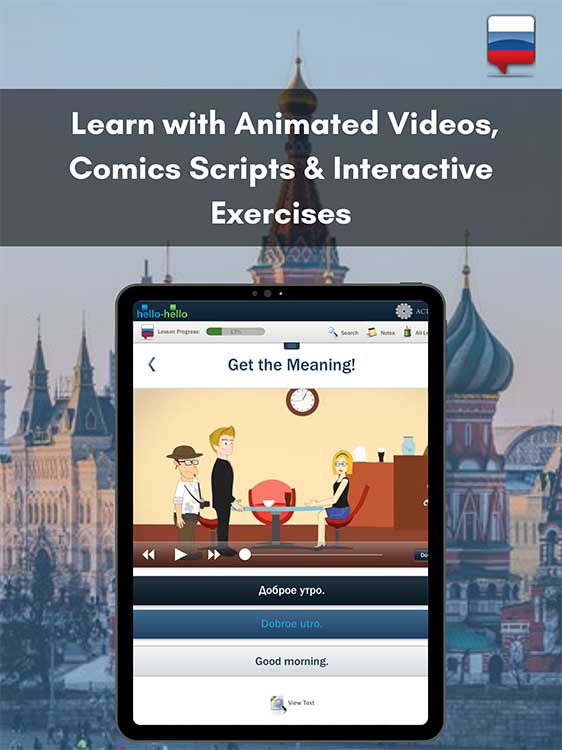
Learn Russian (Hello-Hello) is a full-fledged language course with 30 LESSONS developed in collaboration with the American Council on the Teaching of Foreign Languages (ACTFL), so you can be assured that these lessons follow an effective research-based methodology. All lessons are conversation-based on realistic dialogues and situations, rather than a collection of out-of-context words and phrases.
– Research-based methodology developed in collaboration with the most prestigious institution for language teachers and professionals: The American Council on the Teaching of Foreign Languages – ACTFL – INNOVATIVE METHODOLOGY: Developed in collaboration with ACTFL
– The American Council on the Teaching of Foreign Languages, which is the largest and most respected association for language teachers and professionals. ACTFL’s guidelines are followed by all major universities in the USA.
– COMMUNICATION SKILLS: Learn to communicate effectively from LESSON 1! Hello-Hello offers 30 conversational lessons based on real-life situations rather then a collection of out-of-context words and phrases. Dialogues are presented and then broken down into sentences, where you can practice pronunciation and writing skills
– VOCABULARY BUILDING: Practice vocabulary with hundreds of fun and interactive Flashcards, plus our innovative Build Your Vocabulary exercise, where you can practice alternate words and phrases from within the dialogues.
iTunes store – Learn Russian (Hello-Hello)
Android Play – Learn Russian language